Posted on October 9, 2025

It’s been a while since I last made a post. My mistake was to spend too much time on researching gaming history and diving into all the facts or trying to verify specific information, like looking up the sources etc. This ate up so much time that I ended up doing more research than actually playing games or writing about them. So, I’ve decided to simplify stuff and not go on about the individual game’s history and whatnot. Instead I want to focus more on the game itself and whether it’s still fun to play. So with that in mind, let’s look at the Famicom version of Donkey Kong.
This game was one of the three launch games that arrived with the Famicom in Japan on July 15, 1983. As is often said, the Family Computer, or Famicom for short, was designed around providing a decent home conversion of this classic arcade game from 1981. And if we compare this game to the version available on the Atari 2600 or the Colecovision, then this version does stand supreme. It looks close enough to the arcade version and the controls are also pretty accurate. However, this version misses one of the four original levels, i.e. the pie factory, which is a shame.
Anyway, in Donkey Kong you play as Jumpman, before he became renamed as Mario, the famous Italian plumber we all know and love. But back then he was a total unknown and just a new video game character trying to save his girlfriend from a stubborn gorilla who had previously kidnapped her, and carried her on top of some construction site. So as you’re making your way up the girders going from left to right, climbing stairs, and going right to left again and so on, good old Kong is throwing barrels down along the girders. There’s even some kind of sentient flame popping out of a flaming barrel that follows you. This and the time limit are obviously meant to force the player to move forward instead of taking their sweet time. After all, the arcade machines had to make money. Either way, Jumpman has to avoid all of these obstacles without any regular means of fighting back except for the fixed amount of power-ups per level. These would give you the means to fight back for a limited amount of time, almost like in Pac-man. However, the barrels and the flames respawn indefinitely and you can’t climb the ladders while still having the hammer power-up. It also doesn’t make you absolutely invincible since objects can still hit you if you’re not careful! This happened to me a bunch of times until I adjusted to it. On the one hand this can be a little bit frustrating, on the other hand it makes the game a bit more challenging and interesting, if you’re not 100% invincible after picking up a power-up. It comes with its own downsides and makes for a more interesting challenge.

There’s also a lot more depth to even just the initial level. There are for examples hidden mechanics that are abused by pro players for high level play. Chief among those techniques is barrel steering, where a good player can change the direction of the barrels in his favor by making them overlap one another, thus making it easier or even possible to jump over them. Basically, when you press the D-pad to the left, then barrels to the left of you have a higher chance of rolling down a ladder. The same applies to pushing the D-pad to the right and barrels that are on your right side. This way you can eliminate the threats that these barrels pose, but it doesn’t work all the time. The percentage for this to happen increases with the levels. So, while you’re still on your first loop this might barely ever occur, whereas on later loops of the game this turns into a valuable strategy. However, I’m not quite sure if this even works in the NES version of the game. I tried it while trying to clear several loops of this game, but it didn’t really seem tow ork all that well. That being said, I can understand why Donkey Kong has garnered so much attention. It’s easy to grasp and play while still offering a lot of depth for the more skilled and devoted players.
Coming back to the game mechanics, there are two very distinct features of the control. First of all, the jumps are fixed, i.e. when you press jump you always jump the same height or distance. You can’t control the height or length of the jump by the duration of your button presses. This means that you have to commit to every single jump. A careless jump can easily cost you a life or ruin or run. Second, this game features a lot of ladders. And by that I really mean, lots of ladders! The act of climbing them, however, feels very stiff and awkward. You have to stand really close to them and be careful with pressing up and down, because I’ve had so many instances where Jumpman would just get stuck on a ladder which in turn got me killed. Sometimes he starts climbing, but then stops shortly after. Or I want to get up to the girder and jump over an incoming barrel, but he then doesn’t climb the last few inches, and I get killed. These two factors make the controls really somewhat clunky, in my opinion. It’s still playable and enjoyable, but you definitely need some time to adjust to these controls, especially if you’re used to Mario’s athleticism in modern games, or even the later NES Mario games that would soon follow. But for the early 80s this is probably as fine as it gets.

Moving on to the second level. Whereas many games of this vintage would only have a single screen of action, Donkey Kong distinguished itself by having multiple thus offering more variety. And in this case it’s the spring level. Here Jumpman has to climb a lot more ladders, jump across rising and lowering platforms and evade the occasional flame enemy. But at least Kong doesn’t annoy you with barrels in this stage, so it should be easier, right? Not necessarily. Because the real challenge of this level starts during the final section where you have to climb up a ladder, move to the left and climb up another ladder to save Jumpman girlfriend. However, Kong is throwing springs at you which you have to avoid. This is easier said than done. Maybe on the first or second loop of the game you can still get through this section with relative ease. But in later loops the springs move so fast that you need to have the right strategy and very good reflexes to make it past them. For you see, the springs jump along in one of three patterns and two of them make it impossible to climb the final ladder. From my observation, in later loops you can only climb the ladder if the spring starts very low from the left of Kong’s right foot. If they start from any other position they will eventually jump so high will get you on the top of the ladder, no matter how fast you move and climb. This section was, and actually still is, the breaking point for me. I could never match my reaction speed to this resulting in me burning through my lives on this level, unless I got really lucky. So most of my runs end here during the fourth or fifth loop. Much respect to anyone good enough who can just keep on playing until the game glitches out and you reach the kill screen.
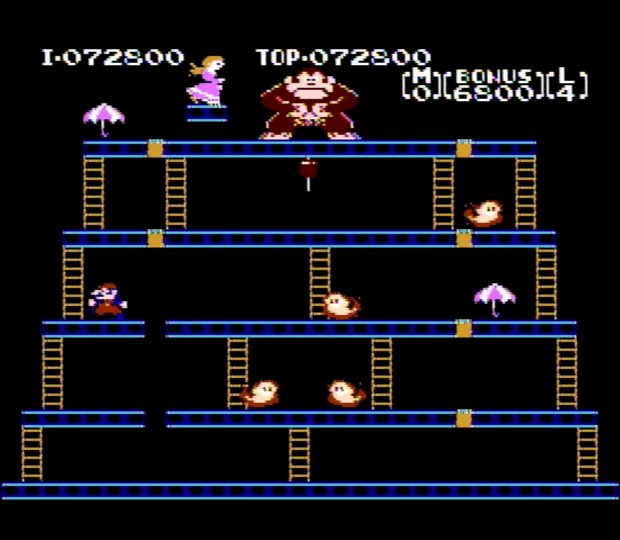
After all this, we finally arrive at the third and final level of the Famicom/NES version of this game. Here we have to, again, climb up girders via ladders and destroy a bunch of joints holding the girders together while avoiding infinitely respawning flames that want to kill us. Jumpman has to walk or jump over these joints, four on the left side and four on the right, in order to finally beat Kong and rescue his girlfriend. Here it’s important to manipulate the spawning of the flame enemies as they only appear on the opposite side of the screen. Therefore, my strategy is first destroying the bottom left joint and the two at the top left, then going down to the hammer on the left side, picking it up and then moving to the right eliminating all the flames in my path. I then move to the right half of the screen to make them respawn on the left side where they are trapped now. But it doesn’t always work on later loops, because the flames spawn so early and move so quickly towards you that there’s not always time for this. You could always jump over the flames, but the move around so erratically that it never reliably works for me. The will randomly follow you, then stand around for a few second or move in the other direction. This makes jumping over them an extremely dangerous move.
Either way, you’ll eventually beat this level and rescue Jumpman’s girlfriend only for the game to start over again, but this time with a higher difficulty. It’s typical stuff for old arcade-style games like this. After all, arcade games had to be short and easy to understand, so that people could immediately start playing while at the same time tweaking the difficulty in such a way, that the average session should only last a few minutes. After all, the arcade machine operators only earned money if people threw in quarters. But at the same time the game needed to be fun enough and offer enough game time and value so that players would return and try again. As such it’s only natural that home consoles with their limited technical capabilities would try to emulate these games instead of offering something more in-depth, like the computer gaming scene back in the day. So, for a launch game for a home console from 1983 this is a perfectly good game to start out with. It’s easy to learn, but hard to master, and offers enough variety to differentiate itself from a good chunk of the competition. It’s unfortunate that only three of the four levels could make it into the home console release, but I’m sure that it was still an enticing enough game for prospective buyers back in the day. Donkey Kong would maybe seem a bit of an old hat by the time it reached the USA in 1985, but at the original time of its console release it as fine of a game as you could hope for.
This leaves me in a difficult position to rate this game. I have thought quite a bit about whether or not I should use a numeric scale to rate these games. But the difficulty comes from what I should base these numbers on: how good the game was for its time? How good it’s compared to the rest of the library? But if I haven’t played all 1000+ Famicom games, can I even rate it? And what about the historical significance of the game? Should that count into a potential rating system? I honestly don’t know. Donkey Kong is a contender for games that every gamer should try, but does that mean, that I’m still coming back for it in the years 2025 or beyond? I might dabble a bit in it here and there and have fun for a while, but it’s not among my favorite games on the system. As such I would probably still give it something along the lines of a 7 out of 10. Before people start picking up their pitchforks, I still believe in using the entire range of the rating system. So I might drop some 1s or 2s later on. I’ve also found some enjoyment in games that I would label a 4 or 3. Some might call this range of games enjoyable Jank and I’m here for it. Either way, Donkey Kong is currently the number 1 game in my ranking since it’s the only game I’ve ranked for this endeavor so far.
Finally, some word about how long I’ve played this game. I’ve mastered the NES version of this game on Retroachievements and played it on and off over the past years. I also recorded a playthrough of me doing a few loops on Mode A and on Mode B, which seems to be about the same. I think you just start one loop later, i.e. loop/level 1 of Mode B probably equates to loop/level 2 of Mode A and so on. My criteria for “beating” arcade games is not playing until the score rolls over or until reaching a kill screen, if that even exists in the game, but instead I go for playing until the game starts looping and beating the pre-set high score. So in short:
Rating: 7/10
Difficulty: 3/10 (for the first loop, later loops would probably be closer to 7 or 8/10)
Time to beat: ca. 5 minutes (for one loop)
Beaten? – Yes. Multiple loops, but no maxed out score or kill screen.
Ranking: #1 (of 1)
 RetroGamingJapan
Leave a comment